What Is YouTube CPM?
Quick Answer
Most guides throw the CPM definition at you and call it done. This one goes further — real rates by niche, why your country kills your earnings, and what you can actually do about it.
What Is YouTube CPM? The Complete 2026 Guide (With Real Niche Data)
Here's something that confused me for a long time: my YouTube Studio was showing a CPM of $9 — but my actual payout was nowhere close to what that number implied.
Turns out, CPM and your real earnings are two very different things. Most guides explain the definition and stop there. This one goes further — real rates by niche, why your audience's country matters more than almost anything else, and five concrete ways to improve what you actually take home.
What Is YouTube CPM?
CPM stands for Cost Per Mille — Latin for "cost per thousand." It's the amount advertisers pay YouTube for every 1,000 ad impressions served on your content.
Key word: impressions. Not views. An impression means an ad was displayed — the viewer may or may not have watched it, clicked it, or done anything with it. YouTube still counts it.
So if your CPM is $5 and your video received 20,000 ad impressions, advertisers paid YouTube $100 total. But that $100 doesn't land in your pocket — YouTube keeps its cut first.
The number in your YouTube Studio dashboard is CPM. Your actual earnings per 1,000 views is RPM. They're related but not the same, and confusing them is one of the most common mistakes new creators make.
CPM vs RPM — The Difference That Actually Matters 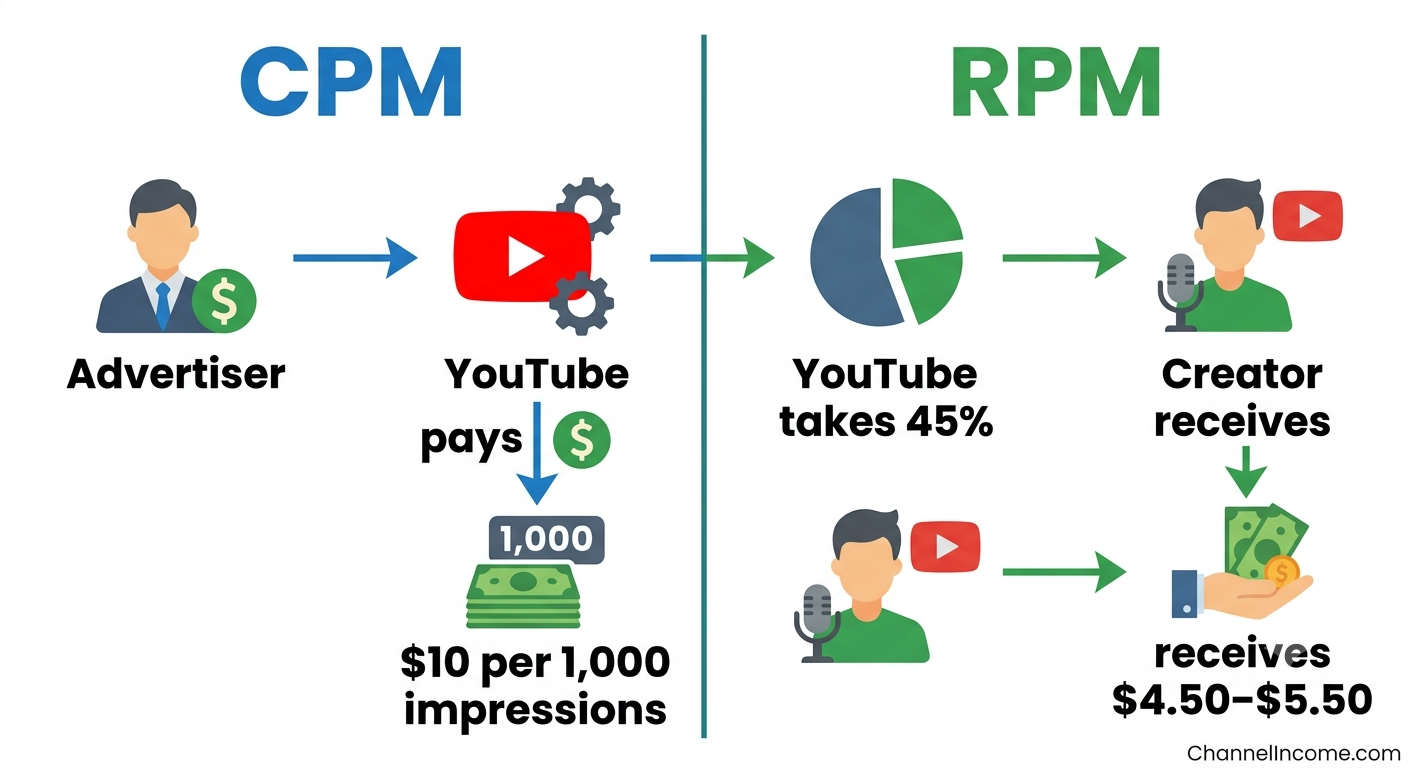
| CPM | RPM | |
|---|---|---|
| Full name | Cost Per Mille | Revenue Per Mille |
| Whose number is it | Advertisers + YouTube | You, the creator |
| YouTube's cut | Not subtracted yet | Already subtracted |
| Typical example | $10 | $4.50 – $5.50 |
| Where you see it | YouTube Studio | YouTube Studio |
YouTube keeps 45% of ad revenue. You receive the remaining 55%. That's built into your RPM figure — which is why RPM is always lower than CPM. There's a second factor that compounds this: not every view is a monetized view. Some viewers use ad blockers. Some skip before a billable impression registers. Some are in regions where advertisers don't bid. The result is that your monetized view rate is typically 60–80% of total views, depending on your audience. The simple formula:
Your Earnings = (Total Views × Monetized Rate × CPM × 0.55) ÷ 1,000
Or use the shortcut on our YouTube Revenue Calculator → — plug in your numbers and see the estimate instantly.
Real CPM Rates by Niche in 2026
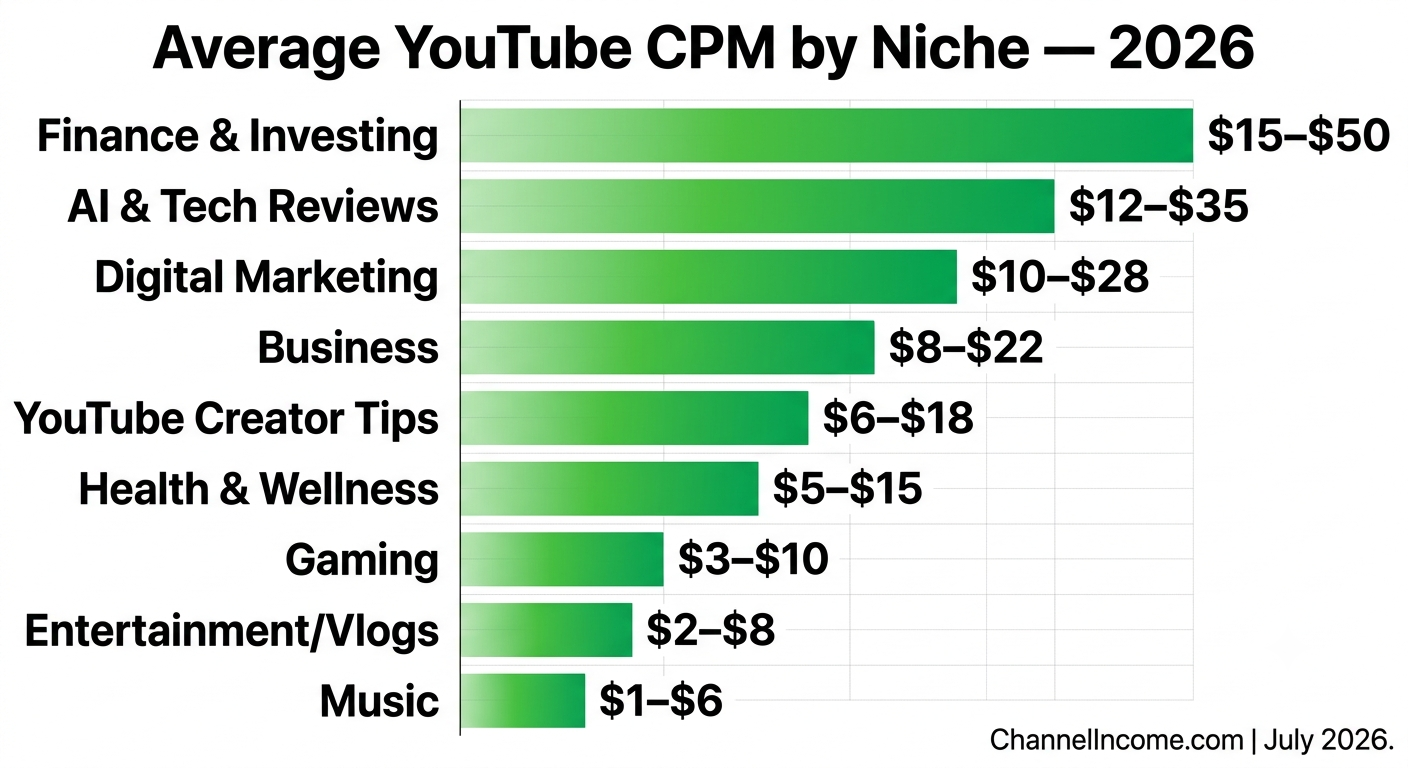
These ranges come from creator-reported data and industry benchmarks current as of mid-2026. Your channel's actual CPM will vary based on audience location, video length, and engagement — but these ranges give you an honest baseline:
| Niche | CPM Range | Estimated RPM |
|---|---|---|
| 💰 Finance & Investing | $15 – $50 | $8 – $27 |
| 🤖 AI Tools & Tech Reviews | $15 – $40 | $8 – $22 |
| 📈 Digital Marketing / SEO | $12 – $35 | $6 – $19 |
| 💼 Business & Entrepreneurship | $10 – $25 | $5 – $14 |
| 🎥 YouTube Creator Tips | $8 – $20 | $4 – $11 |
| 🏥 Health & Wellness | $5 – $15 | $2 – $8 |
| 🎮 Gaming (general) | $1 – $4 | $0.50 – $2 |
| 🎬 Entertainment / Vlogs | $1 – $5 | $0.50 – $2.70 |
| 🎵 Music | $1 – $3 | $0.50 – $1.60 |
The gap between the top and bottom of that table is not small — a finance creator and a gaming creator with identical view counts can have a 10–15x difference in monthly earnings. Same work, same audience size. Completely different outcome.
Why? Because advertisers in the finance space compete fiercely for attention — a financial services company will pay $40 CPM to reach someone watching a "how to invest" video. A gaming advertiser won't pay the same to reach someone watching a Let's Play.
Why Your Country Affects CPM More Than Almost Anything Else bold text
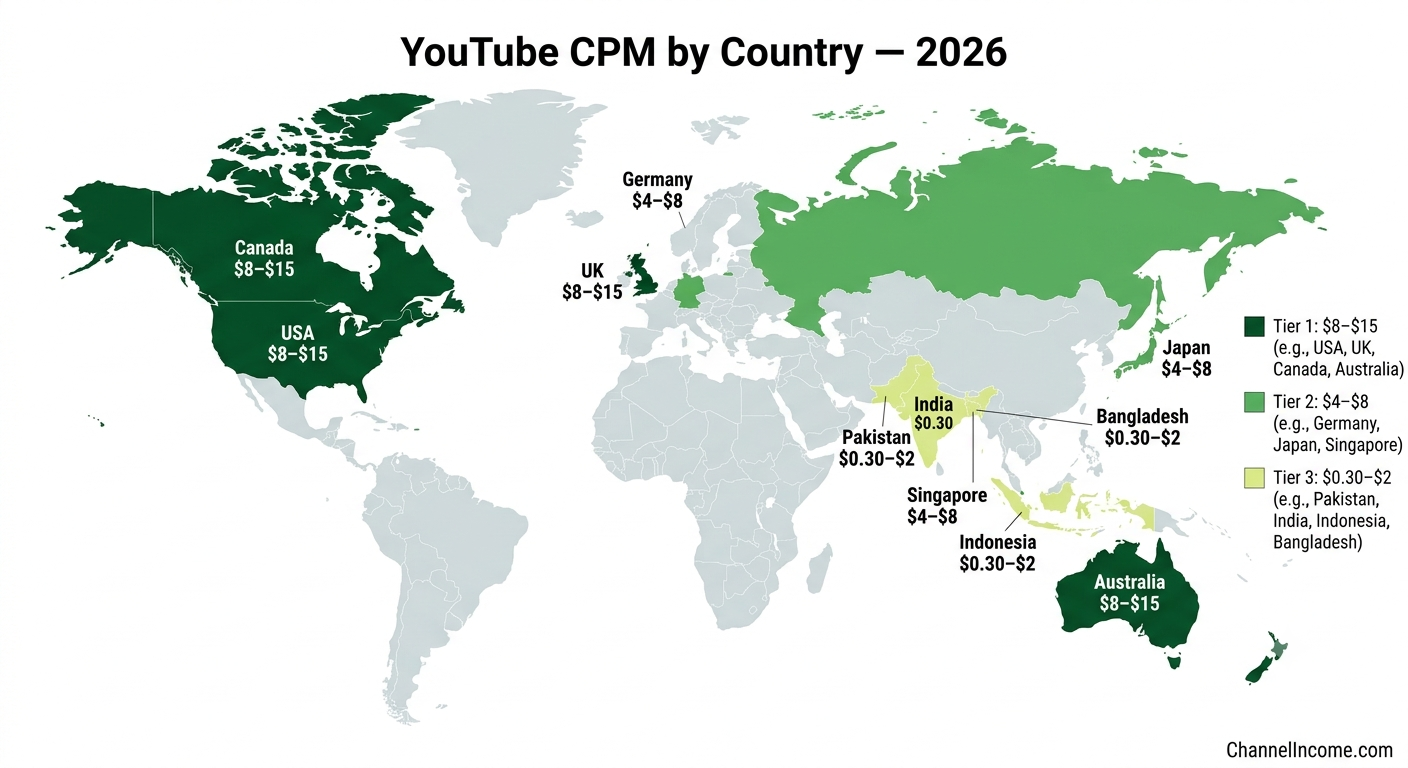 This is the factor most YouTube monetization guides underplay — and it's the one that hits creators in South Asia hardest.
Advertisers bid in real-time for ad placement. They target specific countries, demographics, and interests. Advertisers in the US, UK, and Australia bid significantly more for YouTube placement than advertisers in Pakistan or India — because the average consumer purchasing power, and therefore the return on that ad spend, is higher in Tier 1 markets. **Tier 1 — Highest CPM **
| Country | Average CPM |
|---|---|
| United States | $8 – $15+ |
| Australia | $7 – $13 |
| United Kingdom | $7 – $12 |
| Canada | $6 – $11 |
**Tier 2 — Medium CPM **
| Country | Average CPM |
|---|---|
| Germany | $5 – $9 |
| Netherlands | $4 – $8 |
| Japan | $4 – $7 |
| Singapore | $4 – $7 |
**Tier 3 — Lower CPM **
| Country | Average CPM |
|---|---|
| Pakistan | $0.50 – $2 |
| India | $0.30 – $1.50 |
| Bangladesh | $0.30 – $1 |
| Indonesia | $0.40 – $1.20 |
The honest reality: if 90% of your audience is in Pakistan or India, your CPM will reflect Tier 3 market rates — regardless of your content quality, production value, or upload frequency. This isn't a content problem. It's a market dynamics problem. The solution isn't to abandon your core audience. It's to produce content that also reaches Tier 1 viewers. English titles, English descriptions, and topics with global search demand can surface your videos to US and UK audiences even if you're recording in Urdu.
5 Reasons Your CPM Is Lower Than You Expected
1.Your audience is mostly in Tier 3 countries This is the most common reason and the one with the biggest impact. Go to YouTube Analytics → Audience → Geography. If your top countries are India, Pakistan, or Indonesia, that explains a large portion of a low CPM.
2.You're in a low-advertiser-demand niche Entertainment, gaming, and music content just don't attract high advertiser bids. It's not about effort — it's about who wants to advertise against that content.
3.It's January (or early Q1) Every December, advertisers exhaust their annual budgets on holiday campaigns. January 1st, those budgets reset to zero and rebuild slowly. CPM drops 30–50% in January–February compared to Q4. This is industry-wide and affects every creator. It's not a signal something is wrong — it's seasonal.
4.Your videos are under 8 minutes YouTube enables mid-roll ads only on videos 8 minutes or longer. Mid-roll ads are where a significant chunk of RPM comes from. Short videos are limited to pre-roll only, which drags down your revenue per view substantially.
5.Your audience retention is low The more of your video viewers watch, the more ads YouTube can serve. A video with 70% average watch time generates more ad impressions — and more revenue — than the same video with 25% retention. Low retention compresses your effective RPM even when your CPM is decent.
5 Ways to Actually Improve Your CPM and RPM
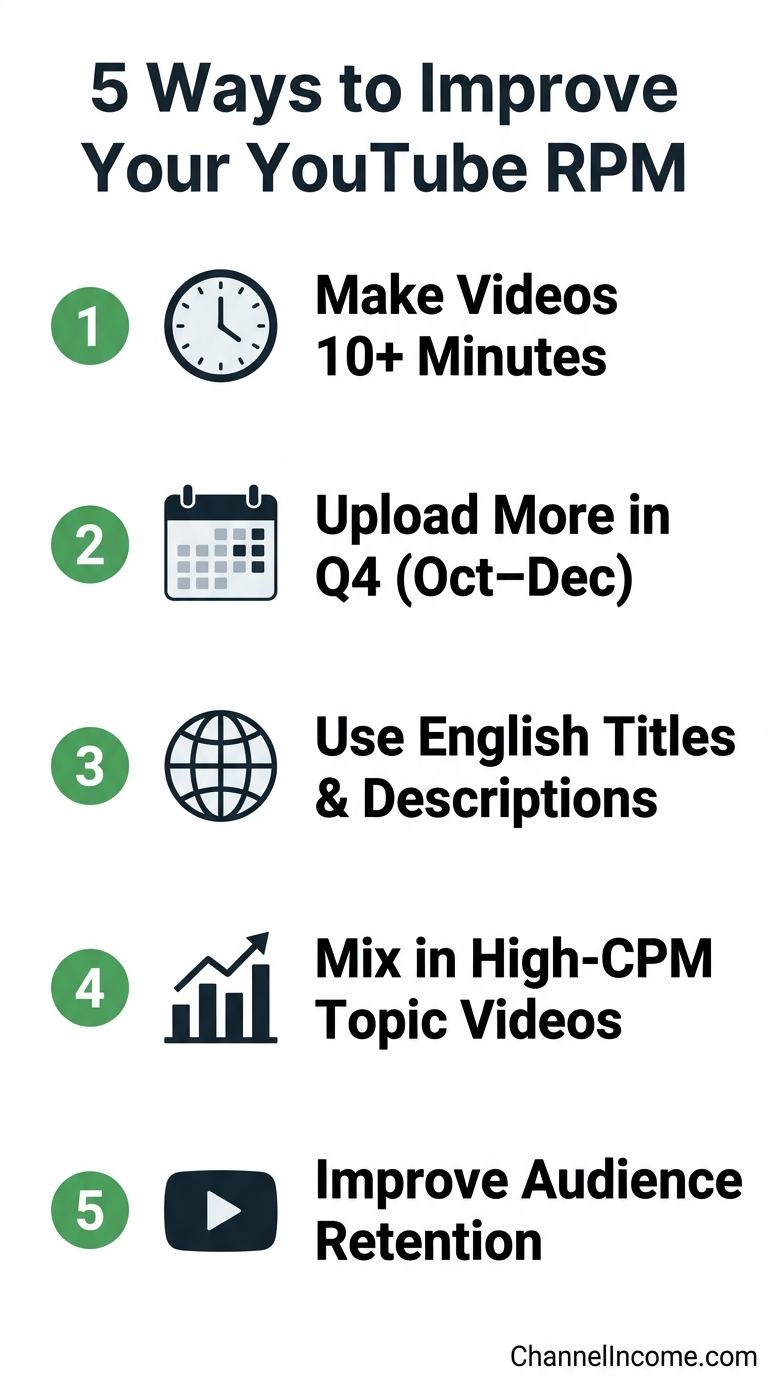 1.Make your videos 10+ minutes long
Eight minutes unlocks mid-roll ads. Ten to twelve minutes consistently outperforms on RPM because YouTube can serve more ad placements throughout. Don't pad your videos — but if your content genuinely supports the longer format, the difference in earnings is real.
1.Make your videos 10+ minutes long
Eight minutes unlocks mid-roll ads. Ten to twelve minutes consistently outperforms on RPM because YouTube can serve more ad placements throughout. Don't pad your videos — but if your content genuinely supports the longer format, the difference in earnings is real.
2.Maximize your Q4 publishing schedule October through December is when advertisers are most aggressive with budgets. CPM spikes 40–60% compared to the annual average. If you have a backlog of polished content or planned series, Q4 is when to publish it.
3.Add English metadata to your content Even if you record in Urdu or another regional language, English titles, descriptions, and tags signal to YouTube's algorithm that your content is relevant to global search queries. This opens your videos to suggestion in Tier 1 markets, which raises your effective CPM over time.
4.Introduce high-CPM topic angles If your channel covers general creator content, deliberately weave in higher-CPM adjacent topics: "how to earn from YouTube," "best AI tools for creators," or "YouTube monetization guide 2026." These videos attract finance and tech advertisers who bid more aggressively.
5.Work on retention, not just view count A video with 500,000 views and 15% average retention earns less than a video with 200,000 views and 65% retention — because the second video serves far more ad impressions per viewer. Retention is the metric that compounds. Front-load your value, cut dead time, and hold attention through the first 30 seconds where most drop-off happens.
How to Calculate Your YouTube Earnings
The formula is straightforward:
Monthly Earnings = (Monthly Views × 0.55 × CPM) ÷ 1,000 Example A — Tier 3 audience, entertainment niche:
- 100,000 views, CPM $1.50
- Earnings: (100,000 × 0.55 × 1.50) ÷ 1,000 = $82.50/month
Example B — Mixed audience, creator tips niche:
- 100,000 views, CPM $10
- Earnings: (100,000 × 0.55 × 10) ÷ 1,000 = $550/month
Same view count. 6.5x difference in earnings. That's the niche and audience location effect in real numbers.
Want to model your specific scenario? Our YouTube Revenue Calculator → lets you change views, CPM, and country to see estimated earnings instantly — no guesswork required.
CPM is not a number you control — but it is a number you can influence through smarter decisions about niche, format, audience targeting, and timing.
The creators earning $500/month from 100,000 views are not working harder than the ones earning $80/month from the same traffic. They're working on different levers: niche selection, audience geography, video length, and seasonal timing.
Start with our YouTube Revenue Calculator → to baseline where you are today. Then use this guide to identify which of the five RPM factors is leaving the most money on the table for your specific channel.
Tags
Frequently Asked Questions
What is YouTube CPM in simple terms?↓
What is the average YouTube CPM in 2026?↓
What is the difference between CPM and RPM on YouTube?↓
When is YouTube CPM highest during the year?↓
Can I directly increase my YouTube CPM?↓
Related Tools
Calculate Your YouTube Earnings
Use our free calculator — enter channel name, views, niche & country for an instant revenue estimate.
Open Free Calculator →